The Sea as Playground: How Jakarta's Poor Children Cool Their Bodies
Kamis, 24 September 2026
Pengunggah: Redaksi
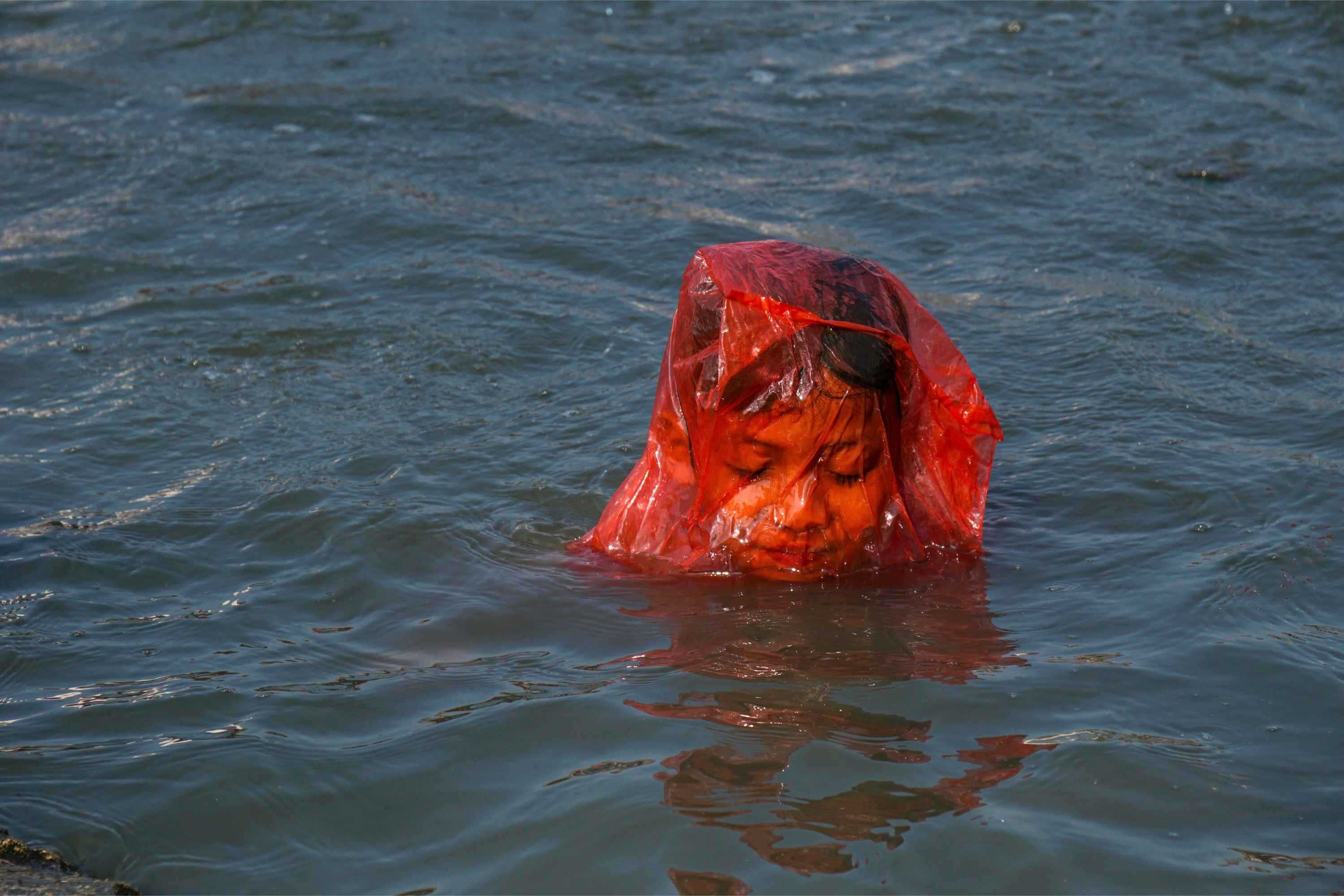
There is a photograph that circulates on Indonesian social media every year, usually around the peak of the dry season. Three or four children, faces bright, arms lifted mid-jump, launching themselves from a wooden pier into the waters off North Jakarta. In the caption, someone always writes a word like bahagia — happy. Sometimes bebas — free. The image is meant to be read as a small victory over hardship. Children finding joy anyway. Resilience.
I want us to look at the same photograph differently.
The water they are jumping into is one of the most polluted urban seas in Southeast Asia. It carries the household waste of more than thirty million people. Its surface is broken by discarded packaging, styrofoam, sachet wrappers, cooking oil bottles. On some days, when the wind is right, the smell reaches the pier before the children do. And still, they jump. Because their bodies are hot. Because their homes hold heat long after dark. Because the alleyways they live in have no tree, no working fan that reaches every room, no “ruang bermain” to run into. Because the sea, at least, is cold.
This is not a story about resilience. This is a story about a city that has left its poor children with two choices for cooling their bodies — a road that could kill them and a sea that is quietly killing them and then decided to call the resulting images beautiful.
Where the playgrounds should have been
Under Jakarta's own spatial planning regulations, the city is required to allocate thirty percent of its area to Ruang Terbuka Hijau, green open space. It has never come close. The most recent independent estimates place the real figure between five and ten percent, and much of that is concentrated in central and southern districts, where children already have gardens, gated-complex playgrounds, air conditioning, and parents who can drive them to a mall on the hottest afternoons.
In the industrial belts of North Jakarta, in relocated coastal communities, in the dense kampung wedged between warehousing and the sea, the ratio collapses. A child there can walk for kilometres without passing a single public playground. What they will pass is asphalt, warehouses, container yards, drainage canals, walls, and finally, if they walk far enough, the coast.
The absence is not natural. It is administrative. Every playground that was never built was a decision. Every plot of land converted to warehousing rather than open space was a decision. Every green-space target that was quietly missed and then quietly forgotten was a decision. The children who grow up in these neighborhoods are not experiencing bad luck. They are experiencing the accumulated results of decades of prioritization that did not include them.
A sea is not a swimming pool
And then there is the sea. When the heat becomes unbearable, when the road becomes too crowded, when the afternoon stretches too long, the children of North Jakarta walk to the coast. They swim off wooden piers still wet from morning fish deliveries. They climb the breakwaters. They cool their bodies in the reclaimed edges of the city. Their parents mostly know. Their parents mostly cannot stop them. The alternative is a child overheating in a room with no ventilation, in a home too small for its number of occupants, on a floor that has already absorbed the day's sun.
Jakarta Bay carries the plastic waste of the largest metropolitan area in Southeast Asia. Research by Indonesian oceanographers has repeatedly documented microplastic concentrations, industrial runoff, and heavy metal levels in these waters that would be treated as a public emergency in a wealthier city. Skin infections are common. Diarrheal illness rises after swimming days. Ear infections follow the deeper dives. Long-term effects on child development from repeated exposure remain under-studied, largely because the children most exposed do not appear in the datasets that would be needed to study them.
These children are cooling their bodies in the accumulated discarded packaging of an entire economy. And the images of them doing it — bright, laughing, jumping are shared as evidence that Jakarta's poor children are, somehow, doing fine.
They are not doing fine. They are adapting to a set of conditions that no child should have to adapt to. The distance between "resilient child" and "abandoned child" is a distance no photograph can capture on its own. It has to be named.
The architecture of who gets to be cool
There is a word in Bahasa Indonesia — dingin. Cool. Cold. Refreshing. In wealthier parts of Jakarta, being dingin is a service. It is delivered by air conditioning, by tinted car windows, by the shaded corridor between the mall entrance and the parking basement, by the swimming pools of private housing complexes, by the tree-lined avenues of neighborhoods planned long ago to protect their residents from the sun.
In the neighborhoods this article is about, being dingin is a hunt. It is a search that sends children into the road and into the sea. It is a search parents cannot afford to lose, because a child who cannot cool down cannot sleep, cannot concentrate at school the next day, cannot recover from a fever, cannot grow.
The city has, in effect, privatized cooling. And it has left the children of the informal workforce to find their own — in whatever public infrastructure remains unclaimed by capital, which in this city means the asphalt and the polluted water.
The distance between the two groups of children is often less than a kilometre. A set of concrete walls. A completed flood barrier here, a stalled one there. A swimming pool on one side, a polluted bay on the other. Two versions of Jakarta living side by side, breathing different air, holding different futures.
What we owe them
Their presence in the road is evidence of a planning failure. Their presence in the polluted sea is evidence of a public health failure. The images of their happiness, real, complicated, earned in the face of everything, are evidence of a childhood still asserting itself against a city that has not decided it is worth protecting.
To photograph them without naming this is to participate in the same narrative that made their situation possible in the first place. They deserve better than being turned into a symbol of resilience. They deserve a playground. They deserve a sea that is not a landfill. They deserve a home that cools down when the sun sets. They deserve a city that includes them in the sentence cooler, safer, more child-friendly.
Penulis : Tiara De Silvanita
Editor : -
Tags
Berita Populer
Berita terkait
There is a photograph that circulates on Indonesian social media every year, usually around the peak of the dry s...
EnvironmentKamis, 24 September 2026
Jakarta, 11 Mei 2026 -- Indonesia pada tahun 2026 kembali dihadapkan pada ancaman fenomena El Nino yang berpotens...
EnvironmentSenin, 11 Mei 2026
In March 2024, Indonesia's Meteorology, Climatology, and Geophysics Agency (BMKG) recorded the country's average ...
EnvironmentKamis, 24 September 2026