When Heat Isn't Equal, it lands hardest on the children with the fewest options in Jakarta
Kamis, 24 September 2026
Pengunggah: Redaksi
In March 2024, Indonesia's Meteorology, Climatology, and Geophysics Agency (BMKG) recorded the country's average temperature at 27.43 degrees Celsius. 0.8 degrees above the monthly average for 1991–2020. The figure came from 115 observation stations. I
There were no protests. No statements from regional heads. No cabinet meetings. The temperature rose, the sun kept rising from the east, and the country carried on with its day, complaining about the heat in family group chats, buying iced tea, switching on the fan, sleeping on tile floors. We have a well-developed vocabulary of adaptation. What we have not yet developed is the willingness to admit that adaptation is a form of defeat.
The people who will inherit this adaptation the longest are the ones with the least say in producing it. They are children.
A road is not a playground
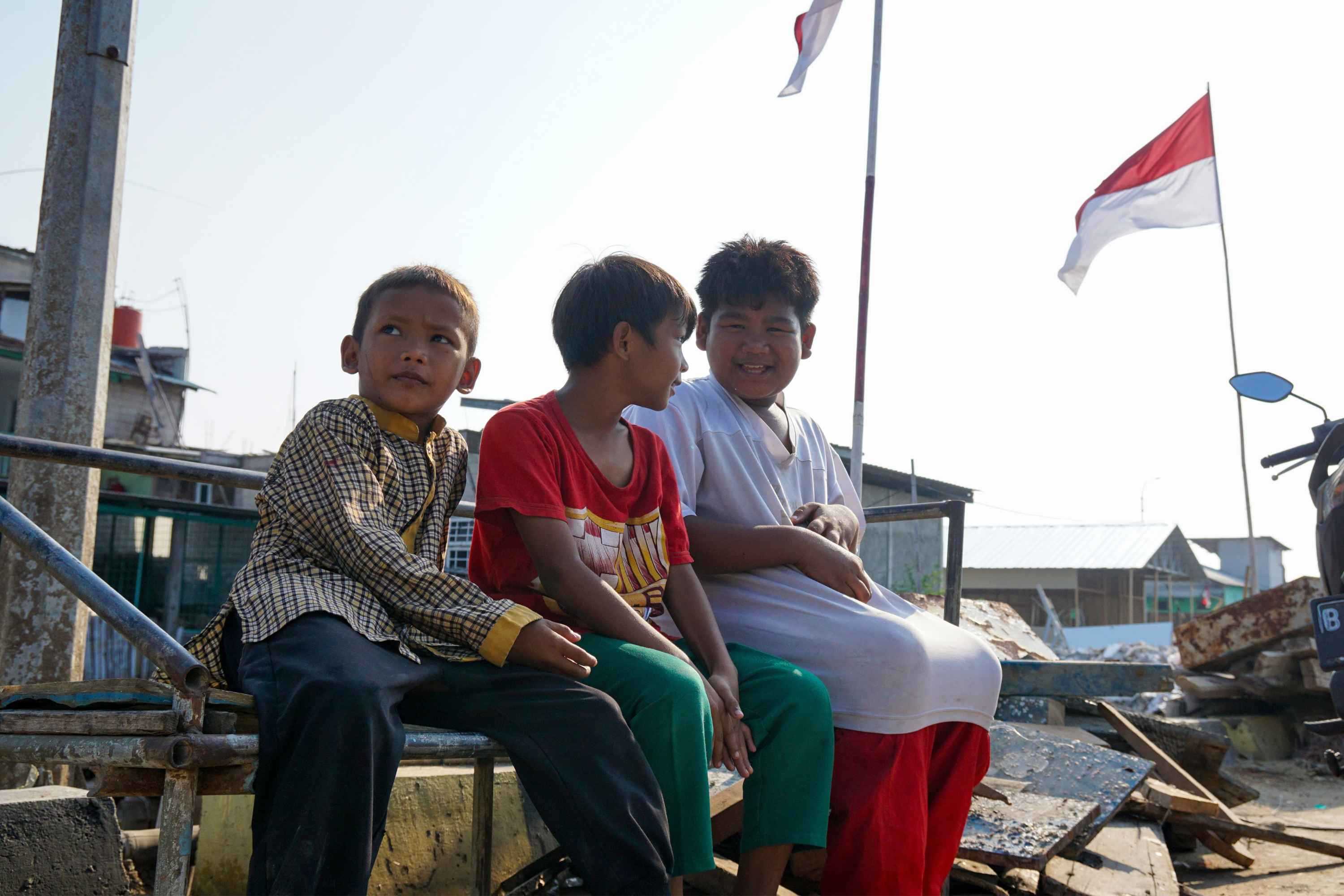
Watch any kampung padat in Jakarta between four and six in the afternoon, and you will see what children do when a city forgets to plan for them. They play in the street. Not on the side of the street — in it. Between the passing motorbikes, the delivery vans, the ojek riders, the honking Grab drivers. Games of running, chasing, cycling on second-hand bicycles too big for their bodies. Marbles played on the edges of pavement. Skipping ropes stretched from one shopfront to another.
They do this because there is nowhere else. They do this because at four in the afternoon, the interior of a kampung house is often hotter than the road outside. They do this because the tile floor they slept on the night before is still holding the day's heat. They do this because childhood, even for a child no city has planned for, still insists on happening.
The cost is legible if you look. Traffic accidents involving children are systematically under-reported in Indonesia, but pediatric emergency wards in North Jakarta hospitals see the pattern every week. What is less legible is the slower cost — the constant vigilance of parents who are already exhausted, the noise, the polluted air the children breathe at exhaust height because they are shorter than the adults planning the roads.
None of this appears in the promotional material for Jakarta. None of it enters the official narrative of a city becoming smarter, greener, more livable.
The numbers behind the pattern
Research published in Lancet Planetary Health in 2021 found that in Berau, East Kalimantan, sixteen years of deforestation raised the average maximum daily temperature by nearly one degree Celsius — three times faster than the global rate. In areas that lost their forest cover, working hours spent outside safe temperature ranges increased tenfold compared to areas that retained their canopy. In Jakarta, the equivalent story has been unfolding for longer. Green cover has been steadily replaced by concrete, asphalt, warehousing, and reclaimed coastline. The urban heat island effect has been documented for decades. What has not been documented is what it does to a body that is still growing.
A 2024 study in Global Change Biology projected that labour productivity in food-producing regions across Southeast Asia could fall by up to 70 percent by the end of this century. That figure has been treated as a story about adult workers. It is also a story about the children of those workers, who are already growing up in the same exposure, in the same neighborhoods, under the same conditions.
The data tells us the climate is changing. What the data cannot capture is the specific texture of what that change does to a child who has not yet had the chance to know any other climate.
An inequality that is no accident
The distribution of heat in Jakarta is not random. It follows the distribution of decisions. Which neighborhoods received tree-lined avenues in the 1970s and which were left as industrial buffer zones. Which schools were built with cross-ventilation and which were built to a minimum standard. Which residential clusters were prioritized for green space and which were left to fill with warehousing. Which children were planned for and which were expected to adapt.
Jakarta's own spatial planning regulations require the city to allocate thirty percent of its area to Ruang Terbuka Hijau — green open space. It has never come close. The most recent independent estimates place the real figure between five and ten percent, concentrated in central and southern districts where children already have gardens, gated-complex playgrounds, and parents who can drive them to a mall on the hottest afternoons. Elsewhere, the ratio collapses.
The children who live in the low-ratio districts are not experiencing bad luck. They are experiencing the accumulated results of decades of prioritization that did not include them. And they are experiencing it in the specific form of a rising thermometer, an under-ventilated classroom, a road doubling as a playground, and a home that will not cool down until midnight.
There is a form of violence we rarely name: the violence of normalization. When a condition that should provoke anger is instead accepted as "the way things are," when adaptation that should be evidence of state failure is treated instead as evidence of civic resilience — that, too, is violence. It leaves no wound you can photograph. What it leaves behind is a generation that no longer asks why the air in their home is hotter than the air in someone else's, why their school feels like an oven and their cousin's does not, why the only cool place they can reach on a Saturday afternoon is a mall they cannot afford to buy anything in.
The children most affected have already adapted. That is the part that should disturb us. Not the temperature itself, but the fact that a generation is quietly learning to expect less from the city — and learning it before they are old enough to name it.
What is left for us?
Extreme heat in Jakarta is not a weather story. It is a story about which children the city considers worth protecting.
We get angry about fuel prices. We get angry about presidential candidates. We get angry about football leagues. We do not get angry that a generation of children is growing up in homes that hold heat past midnight, in classrooms that suppress their ability to learn, in streets that double as their only playground, in a city that has decided, by default, that their comfort is not a design consideration.
Silence is not neglect. Silence is a decision. And every decision to stay silent — in the boardroom, in the newsroom, in the family living room — is part of why this heat no longer feels like a crisis.
What we should fear most is not the heat that is coming. What we should fear most is our willingness to keep calling it normal — until the children who inherited this city no longer remember that Jakarta was once meant to include them.
Penulis : Tiara De Silvanita
Editor : -
Tags
Berita Populer
Berita terkait
There is a photograph that circulates on Indonesian social media every year, usually around the peak of the dry s...
EnvironmentKamis, 24 September 2026
Jakarta, 11 Mei 2026 -- Indonesia pada tahun 2026 kembali dihadapkan pada ancaman fenomena El Nino yang berpotens...
EnvironmentSenin, 11 Mei 2026
In March 2024, Indonesia's Meteorology, Climatology, and Geophysics Agency (BMKG) recorded the country's average ...
EnvironmentKamis, 24 September 2026